
December 2026
On this page
- Message from the President and CEO
- Bringing Tomorrow’s Security to Life
- Modernizing Wait-Time Measurement Through Automation
- Accessibility Improvements That Support a Better Passenger Experience
- Enhanced Screening Procedure for Passengers Travelling with Cremated Remains
- Continuing to Modernize Canada's Screening Checkpoints
- CATSA by the Numbers
Message from the President and CEO
Delivering secure and efficient security screening remains a key focus at CATSA.

Passenger volumes continue to grow, technology continues to evolve, and expectations around service remain high. Our response is straightforward: improve efficiency through modernization and automation. Across our operations, we are investing in advanced technologies and processes that strengthen security, support better decision-making and help passengers move through screening more efficiently.
The CATSA initiatives featured in this edition of our biannual newsletter highlight precisely how our efforts to increase efficiency are translating into practical improvements for passengers, screening operations and partners.
As we approach the end of 2026, I want to thank you for the support you've shown throughout the year. The progress we've made across a number of initiatives has been strengthened by your collaboration and expertise. We value that partnership and look forward to continuing it in the year ahead.
Sincerely,
Neil Parry, President and CEO
Canadian Air Transport Security Authority
Bringing Tomorrow’s Security to Life
This fall, CATSA unveiled its five-year vision for the future screening checkpoint in a video illustrating a more modern, seamless and touchless screening experience that leverages automation, advanced screening technologies, data and an accessibility-focused design.
While the video presents a five-year vision, the concepts and initiatives it illustrates are already being explored, evaluated or implemented today.
Modernizing Wait-Time Measurement Through Automation
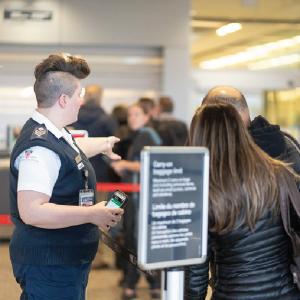
One such initiative is the Wait-Time Sensor.
CATSA is continuously looking for ways to help screening operations work more efficiently, meet passenger needs, and make the best use of available resources. As part of this effort, CATSA recently launched a Request for Proposals for a national automated Wait-Time Sensor solution.
This initiative is intended to reduce reliance on manual wait-time collection over time and to modernize how wait-time information is captured, while enhancing operational visibility, auditability and forecasting capabilities. It builds on a trial conducted at Calgary International Airport, which confirmed that accurate automated wait-time measurement is feasible in a live checkpoint environment and provided important insights that are helping inform the next stage of the project.
CATSA will continue to share wait-time information with airport authorities as it does today. We will also work collaboratively with airports to determine how the Wait-Time Sensor solution may align with existing systems, passenger-flow tools, information-sharing considerations, shared infrastructure opportunities where compatible, and other local initiatives.
Implementation planning would begin after a vendor and solution are selected in early 2027, with rollout anticipated to be completed by mid-2029.
Accessibility Improvements That Support a Better Passenger Experience
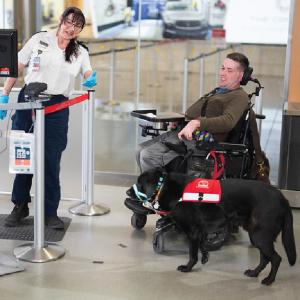
As part of our broader focus on accessibility, CATSA is advancing initiatives that help create a more intuitive and inclusive screening experience for travellers with diverse needs.
CATSA is investing in professional training to qualify for the Rick Hansen Foundation (RHF) Accessibility Certification designation, which will serve to strengthen our in-house ability to evaluate the accessibility of screening checkpoints across Canada. This is in addition to our recent engagement with the RHF, shared in our last update, to conduct an accessibility assessment of the domestic, international and transborder pre-board screening checkpoints at Ottawa International Airport.
That assessment reviewed the screening environment from the perspective of travellers with varying accessibility needs and identified both strengths and opportunities for improvement.
Planning is now underway to replace single-ribbon stanchions with cane-detectable double-ribbon stanchions, and to introduce additional chairs with arms in screening line areas. While these enhancements are relatively simple, they can improve wayfinding, increase comfort and support greater independence for travellers with a range of accessibility needs.
Taken together, these initiatives reflect CATSA's commitment to making screening more accessible and ensuring a barrier-free, inclusive and respectful experience for all passengers.
Enhanced Screening Procedure for Passengers Travelling with Cremated Remains

We understand that passengers may wish to bring cremated remains on the plane with them to keep their loved one close. While cremated remains are generally permitted, this depends on whether screening can be successfully completed in accordance with regulations set by Transport Canada. Cremation container alarms may not be resolvable during screening, which has resulted in instances of cremated remains not being permitted past the screening checkpoint.
In response, CATSA worked closely with Transport Canada to identify an enhanced screening procedure that may help minimize these occurrences. Given the deeply personal and sensitive nature of travelling with cremated remains, this approach is intended to help reduce the number of alarms that cannot be resolved under the current procedure, while continuing to meet security requirements.
A trial to assess the effectiveness and operational impacts of the enhanced procedure is currently underway. Trial results will be used by Transport Canada to inform its decision on whether to approve the procedure for use on a long-term basis.
CATSA continues to recommend that passengers consider alternative transportation methods, such as cargo air services, particularly for cremated remains of 350 mL or more.
Continuing to Modernize Canada's Screening Checkpoints
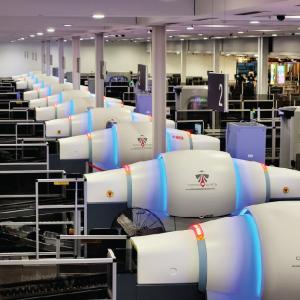
Checkpoint modernization remains one of CATSA's largest and most important investments in both security effectiveness and operational efficiency. Since CT X-ray technology was first introduced in September 2024, deployment of new units has continued steadily across the network, with 94 machines now in place across 10 airports. By July 1, 2026, 51% of passengers screened at designated airports were being screened at lines equipped with CT.
CATSA is also exploring opportunities to incorporate queue-management technology into pre-board screening checkpoints. The objective is to direct passengers to screening lines in a more efficient manner while making the best possible use of available screening capacity. A proof of concept is currently planned for a Class 1 airport checkpoint in 2027.
In addition, CATSA is looking at ways it can leverage trusted biometric Digital Travel Credentials to support a touchless passenger journey and is working with partners to explore how common-use credentials can help create a more integrated and seamless airport experience. The objective is to reduce reliance on physical documents and help passengers move through the pre-board screening checkpoint using secure digital credentials while maintaining the security and privacy standards Canadians expect. This work includes collaboration with the Canada Border Services Agency and industry partners on potential proof-of-concept trials, as well as exploration of a touchless entry process for NEXUS members using the Verified Traveller line.
Modernization efforts extend beyond pre-board screening. Within hold baggage screening operations, CATSA continues to replace aging equipment with newer high-speed CT X-ray technology as part of our lifecycle management program. Most recently, the replacement of legacy units at Halifax Stanfield International Airport was successfully completed in June 2026, and work is underway to replace units in Edmonton and Toronto.
These investments are helping create a screening system that is more effective, more efficient and better positioned to support future passenger growth.
CATSA by the Numbers
As part of our commitment to transparency, CATSA maintains a dedicated Key Performance Indicator (KPI) webpage that highlights overall service metrics and performance. Updated quarterly, it provides a clear view of service levels and reinforces our accountability to the public and our partners.
Q2 2026-27
Wait Time Service Levels
96.0%
Q2 2026-27
Screened Traffic
19,586,035
Q2 2026-27
Passenger Experience
Spread the Word
Know someone in your organization who would benefit from receiving future editions of Beyond the Checkpoint? Please invite them to subscribe.