
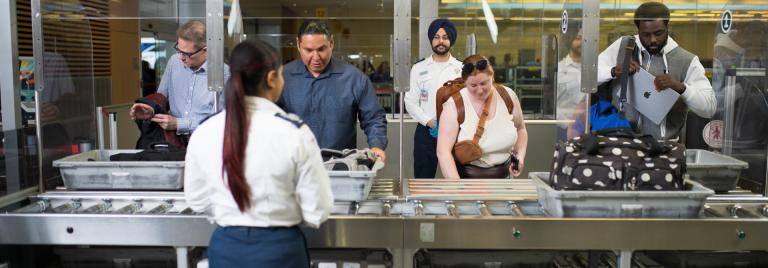
The Canadian Air Transport Security Authority (CATSA) was established on April 1, 2002, following the events of September 11, 2001, to strengthen Canada’s aviation security framework. Created under the CATSA Act, CATSA centralized airport screening responsibilities previously held by airlines, ensuring a consistent and accountable approach to passenger safety.
Since then, CATSA has become a cornerstone of Canada’s air transport system, operating at 89 designated airports.
Mandate
CATSA’s mandate is to secure critical elements of the air transportation system through effective, efficient and consistent screening services. This includes screening passengers, baggage, airport workers and controlling access to restricted areas.
CATSA operates under the CATSA Act and is guided by the Government of Canada’s aviation security policies, with oversight from Transport Canada.
Learn more in our Corporate Plan
Pre-board screening (PBS)
At airport security checkpoints across the country, security screening of passengers and their belongings is conducted by CATSA’s screening officers prior to their entry into the secure area of an airport.
Screening officers use a variety of screening technologies and procedures to prevent passengers from carrying prohibited items beyond the screening checkpoint.
Visit our Security Screening section to learn more about the screening process
Hold baggage screening (HBS)
Screening officers use specialized equipment to screen passengers’ checked baggage (or hold baggage) to prevent the boarding of prohibited items such as explosives.
CATSA provides financial support to airports to cover the installation, renovation and deployment of explosives detection systems. Collaborating with Transport Canada, CATSA has established a regulatory framework to ensure optimal performance and maintenance of each system. CATSA also oversees all hold-baggage screening systems and ensures regulatory compliance.
Non-passenger screening (NPS)
Transport Canada introduced non-passenger screening (NPS) regulations in 2004 to enhance both airport and civil aviation security.
CATSA’s screening officers conduct screening of non-passengers accessing restricted areas at major airports. Non-passengers include flight and cabin crews, airline customer service personnel, caterers, maintenance personnel, baggage handlers and other airport staff.
Screening occurs during airport operational hours at doors leading into restricted areas and at random within those zones. In addition, several checkpoints equipped with biometric technology are located at some of the largest airports.
NPS continues to evolve as a program; the one constant is the need for cooperation between screening officers and non-passengers to make the process hassle free. The vast majority of screenings are quick and routine, but mutual respect helps ensure a smoother process for everyone involved. Ultimately, non-passengers must comply with NPS or risk losing their access privileges.
Restricted area identity card (RAIC)
The RAIC system, created by CATSA in partnership with Transport Canada and airport authorities, uses iris and fingerprint biometric identifiers to allow non-passenger access to the restricted areas of airports. The final authority that determines access to the restricted areas of the airport is the airport authority itself.
Mission
CATSA protects the travelling public by providing the highest level of aviation security screening.
Vision
The travelling public and our partners benefit from the most secure aviation security screening service and the best client experience through our leadership.
Values
CATSA’s values reflect its commitment to integrity, service, and security:
- Integrity – We are driven by a strong conviction in our mandate and mission. We are stewards of public funds, and we act ethically and transparently to foster accountability and public trust.
- Innovation – We are steadfast in our commitment to implementing forward-thinking, creative solutions to evolving and emerging challenges.
- Collaboration – We believe that collaboration is fundamental within the organization, across the aviation industry, and with our partners. We leverage our collective strengths and experience for the benefit of all.
- Inclusivity – In all aspects of our business, respect and inclusivity are central to our approach. We are leaders in the implementation of meaningful actions, dedicated to creating a barrier-free experience for our clients, screening officers, and workforce.
These values guide our daily operations and long-term strategic direction.
Learn more in our Strategic Plan
Role in National Security
CATSA plays a vital role in Canada’s national security infrastructure by:
- Preventing prohibited items from entering aircraft cabins and cargo holds
- Supporting the Passenger Protect Program (Canada’s “No Fly List”) in coordination with Transport Canada
- Ensuring secure access to restricted airport zones through biometric identity verification
- Collaborating with law enforcement and intelligence agencies to respond to threats
By maintaining rigorous screening standards and adapting to emerging risks, CATSA helps protect Canadians and uphold the integrity of the national transportation network.