
I - Introduction
The purpose of the Access to Information Act, (“the Act”), is to provide a right of access to information contained within records under the control of federal departments and agencies of government. The Act responds to the principle that government information should be available to the public with limited exceptions to the right of access and that the disclosure of government information should be evaluated independently of the executive arm of government.
This Annual Report on the Canadian Air Transport Security Authority’s (CATSA) administration of the Act has been prepared in accordance with Section 94(1) and is hereby submitted for tabling in Parliament under Section 94(2) of the Act.
This is report serves as CATSA’s 22nd Annual Report on Access to Information and coincides with its establishment twenty-one years ago. CATSA remains focused on its mandate of civil aviation security screening of the traveling public with the greatest degree of security while providing the best possible screening service for passengers and their baggage.
Previous such reports are available under the “Reports and Summaries” heading of the “Privacy” page on the website and the Open Government website.
During 2024-2025, CATSA has no non-operational subsidiaries during this reporting period.
The Canadian Air Transport Security Authority - Mandate
Established as an agent Crown Corporation on April 1, 2002, CATSA‘s mandate is to protect the public by securing critical elements of the air transportation system as assigned by the Government of Canada.
Fully funded by parliamentary appropriations, CATSA is accountable to Parliament through the Minister of Transport. CATSA is governed by a Board of Directors. Operations are directed by a senior management team. CATSA currently contracts security screening to third-party contractors.
CATSA delivers on its mandate of securing Canada’s air transportation system by conducting the following activities across eighty-nine of Canada’s designated airports:
- Pre-Board Screening (PBS) - The screening of passengers and their belongings prior to their entry into the secure area of an air terminal building;
- Hold Baggage Screening (HBS) - The screening of passengers’ checked (or hold) baggage to prevent the boarding of prohibited items;
- Non-Passenger Screening (NPS) - The random screening of non-passengers accessing restricted areas; and
- Restricted Area Identity Card (RAIC) - The program that uses iris and fingerprint biometric identifiers to allow non-passenger access to the restricted areas of airports.
Under an agreement concluded with Transport Canada in 2010, CATSA has the authorization to conduct screening of cargo at smaller airports if there is capacity to do so. Each of these activities is conducted effectively, efficiently, consistently, and in the public interest, as required by the CATSA Act.
II- Organizational Structure
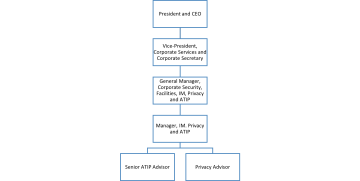
Org Chart Details
- President and CEO →
- Vice-President, Corporate Services and Corporate Secretary →
- General Manager, Corporate Security, Facilities, IM, Privacy and ATIP →
- Manager, IM, Privacy and ATIP→
- Senior ATIP
- Privacy Advisor
- Manager, IM, Privacy and ATIP→
- General Manager, Corporate Security, Facilities, IM, Privacy and ATIP →
- Vice-President, Corporate Services and Corporate Secretary →
Responsibility for processing requests received under the Act rests with the Manager, IM, Privacy and ATIP, who is also the organization’s Access to Information and Privacy (ATIP) Coordinator. A Senior ATIP Advisor supports the ATIP Coordinator in processing requests under the Act. During this fiscal year, a consultant was hired to provide assistance to the ATIP program as the Senior ATIP Advisor position was vacant.
The ATIP Coordinator reports directly to the General Manager, Corporate Security, Facilities, and Information Management. The Vice-President, Corporate Services and Corporate Secretary serves as CATSA’s Chief Privacy Officer (CPO). The CPO reports directly to the President and Chief Executive Officer.
CATSA’s ATIP Office responsibilities regarding the Act are as follows:
- receive and process all requests in accordance with the Act;
- assist requesters in formulating their requests when required;
- gather all pertinent records from the program areas and ensure that the search for information is rigorous and complete;
- conduct the initial record review and provide recommendations to the program areas;
- conduct all internal and external consultations;
- consolidate the recommendations and apply all discretionary and mandatory exemptions under the Act;
- assist the Office of the Information Commissioner (OIC) in all access to information related matters including complaints against CATSA;
- prepare annual reports on the administration of the Act;
- provide ongoing advice and guidance to senior management and staff on matters related to access to information;
- promote access to information awareness by providing training sessions to ensure that all staff are aware of the obligations imposed by the legislation;
- respond to consultations received from external organizations;
- develop and maintain access to information policies and guidelines;
- stay current on, and promulgate within CATSA, any changes to administrative requirements for the Act from the Treasury Board of Canada Secretariat, or guidance prepared by the Office of the Information Commissioner; and
- participate in ATIP community activities and ATIP community meetings.
During the 2024-2025 fiscal year, CATSA was not party to any service agreements under section 96 of the Access to Information Act.
Access to Information and Privacy Communities Development Office (APCDO) Membership
Since 2022, TBS established the Access to Information and Privacy Communities Development Office (APCDO). CATSA joined the membership to continue to develop our visibility as a smaller ATIP office. APCDO was established to provide ongoing support to ATIP offices for the recruitment activities and retention of ATIP professionals.
CATSA membership has benefited from the valuable guidance on the development and training of practitioners, which in turn strengthens the ATIP community. The APCDO has hosted various workshops, InfoBlitz and Deep Dive sessions, that give timely information about ongoing issues and guidance on how to effectively manage the Access to Information Program.
For the breakdown of the group(s) and/or position(s) responsible for meeting each applicable proactive publication requirement under Part 2 of the Access to Information Act, see the section.
III - Delegation Of Signing Authority
In accordance with section 95(1) of the Act, a delegation order, signed by CATSA’s President and Chief Executive Officer (CEO) designates the person holding the position of ATIP Coordinator to exercise and perform the access to information duties on behalf of the organization.
The signed and dated delegation order is attached to this report as Annex A.
IV - Performance 2024-2025
Access to Information Act Requests Received and Completed
For the fiscal year of 2024-2025, CATSA received thirteen (13) new Access to Information Act requests, which is five (5) requests less than the eighteen (18) requests received in the previous fiscal year. This represents a 32% decrease. There were three requests carried over from 2023-2024. In total, CATSA was responsible for sixteen (16) requests in 2024-2025.
During 2024-2025 of the eleven (11) requests completed, CATSA processed 1767 pages , an average of 135 pages per completed request. The number of pages processed represents an increase over the previous fiscal year.
Chart I: Annual Formal Requests Received
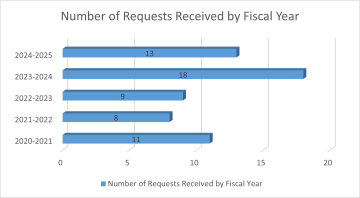
Chart I details
| Fiscal Year | Number of requests received |
|---|---|
| 2024-2025 | 13 |
| 2023-2024 | 18 |
| 2022-2023 | 9 |
| 2021-2022 | 8 |
| 2020-2021 | 11 |
Informal Access Requests
For the 2024-2025 fiscal year, CATSA received twenty-nine informal1 Act requests for information that was previously released. CATSA has remained consistent in completing these informal requests within 15 days with the majority being completed within a 2-to-3-day turnaround. These requests processed 8,061 pages of records that had been previously released through Open Government. CATSA continues to ensure the pro-active release of information on closed Act files.
1 Informal requests are defined as previously released Access to Information Act request packages.
Completion Time
During fiscal year 2024-2025 of the eleven (11) Act requests completed:
- 7 requests (64%) completed within 30 days or less;
- 2 requests completed in 31 to 60 days;
- 1 request completed in 61 to 120 days;
- 1 request completed in 121 to180 days;
Active Requests
At the end of the is reporting period, CATSA had four (4) active ongoing requests. Three from the 2023-2024 reporting period and one from 2024-2025.
Complaints
During this fiscal reporting period, CATSA has no ongoing complaints, nor did they receive any new complaints.
Source of Access to Information Act Requests
The media accounted for seven (54%) of the 13 new requests, followed by the public with five (38%) and one requester who declined to identify, which accounted for 8% of the requests.
Chart II: Source of Access to Information Act Requests
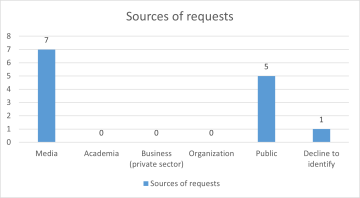
Chart II details
| Source | Number of requests received |
|---|---|
| Media | 7 |
| Academia | 0 |
| Business (private sector) | 0 |
| Organization | 0 |
| Public | 5 |
| Decline to identify | 1 |
Disposition of Completed Access to Information Act Requests
The 11 completed requests consisted of:
- 4 requests were disclosed in part;
- 2 requests were all disclosed;
- 1 request was transferred to another institute; and
- 4 requests had no records.
For all requests that were disclosed, the records were released electronically.
Exemptions Invoked
Where Access exemptions were invoked, these reasons were cited:
| Reason | Exemption | Number of Cases |
|---|---|---|
| Security | S.16 | 2 |
| Personal information | S.19 | 3 |
| Third-party information | S.20 | 1 |
Extensions
During the 2024-2024 fiscal year, there were only four (4) requests where extensions were taken. Two of the requests that were extended due to the potential for interference with the operations of the Organization, one for other consultation requirements and the last one was for third-party notice. After extensions were applied, two requests were completed in 30 days or less, and the other two requests were fulfilled between 31 to 60 days.
Consultations Received from Other Government Departments
This fiscal year, CATSA received just three consultations. The Ontario Ministry of Tourism provided one consultation, while the Treasury Board Secretariat and RCMP provided two from Government Organizations. Every consultation was completed during the reporting period and within the requested time frames. There were no incomplete or outstanding files at the end of the fiscal year.
The full Statistical Report on the Administration of the Act is attached as Annex B.
V - Training and Awareness
The team responsible for Access to Information and Privacy offers ATIP orientation training to all new employees. In 2024-2025, 72 employees received this orientation training.
CATSA continually provides one-on-one ATIP support available to employees, as needed, to clarify the Authority’s expectations for the implementation of the Act.
VI - Policies, Guidelines, and Procedures
The CATSA ATIP Office continues to keep the procedures and the ATIP manual current with the most recent practices by the guidance offered by the Treasury Board Secretariat in their training and information sessions. The objective of this ATIP manual is to ensure continued improvement to the treatment of CATSA’s access to information files and ongoing focus on the reduction of their processing time.
The CATSA ATIP Office participated in workshops, InfoBlitz and Deep Dive session hosted by Access to Information and Privacy Communities Development Office (APCDO).
The Department met its obligations under Part II – Proactive Publication.
VII - Initiatives and Projects to Access to Information
CATSA’s ATIP Program is a strong advocate of collaboration, both internally within the organization as well as within the ATIP Community.
The ATIP Office has undertaken a review of our ATIP Program in order to improve our internal processes, increase our responsiveness, and request processing time by refining our policies and procedures, and incorporating modern technology, such as ATIP RPSS.
Transport Canada - CATSA and Transport Canada work closely to ensure that any similar requests for activities that both organizations perform are treated consistently. CATSA continues to look forward to future opportunities to collaborate with colleagues in Transport Canada’s ATIP Office.
ATIP Community – CATSA’s ATIP Office regularly engages with other federal departments, crown corporations and agency ATIP offices, which has considerable value. The ability to collaborate with other federal departments, crown corporations and agency ATIP offices allows for an opportunity to seek out advice on common issues unique to these institutions. Treasury Board Secretariat quarterly ATIP community meetings provided the ATIP Coordinator and the Senior ATIP Advisor the opportunity to exchange knowledge and experiences with all members of the community.
ATIP Request Processing Software Solution (RPSS) – CATSA has completed the procurement process to modernize the processing software that the ATIP Office uses for requests. The project will be implemented throughout the next fiscal year and is a key initiative to elevate our ATIP operations into the digital age, while leading to better service for Canadians seeking access to government information.
VIII - Summary of Key Issues and Actions Taken on Complaints
During the 2024-2025 fiscal year, CATSA continued to have no new or ongoing complaints. CATSA’s ATIP Office places a high priority on the processing and settlement of all complaints and will work closely with OIC investigators on any complaints received.
The OIC has not conducted any audits in relation to CATSA’s obligations under the Act during the reporting period.
IX - Proactive Publication under part 2 of the ATIA
For the purpose of proactive publications (pursuant to Part II of the Access to Information Act, CATSA is considered a “government institution as defined in section 3 of the Access to Information Act.
| Legislative requirement | Section | Area of CATSA responsible for facilitation |
|---|---|---|
| Travel Expenses | 82 | Financial Operations, Compliance and Reporting |
| Hospitality Expenses | 83 | Financial Operations, Compliance and Reporting |
| Reports tabled in Parliament | 84 | ATIP Office |
* All Government Institutions as defined in section 3 of the Access to Information Act.
CATSA published proactive publication requirements during the fiscal year on the Open Government website including:
CATSA's Annual Report on Travel, Hospitality and Conference Expenditures
CATSA’s Reports tabled in Parliament
All proactive publication requirements were completed during the fiscal year and within legislative timelines. Travel and hospitality reporting is completed monthly.
Travel and Hospitality expenses procedures follow CATSA’s Travel, Hospitality, Conference and Event Expenditures Policy that outlines the information required to report on monthly and is published on the Open Government portal.
X - Monitoring Compliance
During the 2024-2025 fiscal year, CATSA has created a monthly tracker to monitor the time taken to process ATIP requests. The tracker is distributed to all senior management for their review.
The ATIP Coordinator, the Senior ATIP Advisor and Privacy Advisor meet weekly to discuss the status, process of all requests and develop strategies to support the right of public access to information, both in contracts, and information sharing agreements.
CATSA monitors the accuracy and completeness of proactively published information under Part 2 of the Act by ensuring that the scope and wording of the request is based on the type of records released. Once the information has been reviewed, it is then translated in both official languages.
Annexes
Annex A: Delegation Order – Access to Information Act
Annex B: Statistical Report on the Administration of the Access to Information Act
Annex C: Supplemental Statistical Report on Access to Information Act and the Privacy Act