
On this page
- I. Introduction
- II. Organizational Structure
- III. Delegation of Signing Authority
- IV. Performance 2025-2026
- V. Training and Awareness
- VI. Policies, Guidelines, and Procedures
- VII. Initiatives and Projects to Improve Privacy
- VIII. Summary of Key Issues and Actions Taken on Complaints
- IX. Material Privacy Breaches
- X. Privacy Impact Assessments
- XI. Public Interest Disclosures
- XII. Monitoring Compliance
- Annex
I. Introduction
The purpose of the Privacy Act, (“the Act”), is to strengthen Canada’s laws that protect the privacy of individuals with respect to personal information about themselves held by a government institution and that provide individuals with a right of access to that information.
This Annual Report on the Canadian Air Transport Security Authority’s (CATSA) administration of the Privacy Act has been prepared in accordance with section 72 of the Privacy Act.
Previous reports are available under the corporate publications page on our website and the Open Government website.
Mandate of the Canadian Air Transport Security Authority
Established as an agent Crown Corporation on April 1, 2002, CATSA’s mandate is to protect the public by securing critical elements of the air transportation system as assigned by the Government of Canada.
Fully funded by parliamentary appropriations, CATSA is accountable to Parliament through the Minister of Transport. CATSA is governed by a Board of Directors. Operations are directed by a senior management team. CATSA currently contracts security screening to third-party contractors.
CATSA delivers on its mandate of securing Canada’s air transportation system by conducting the following activities across 89 of Canada’s designated airports:
- Pre-Board Screening (PBS) - Screening of passengers and their belongings prior to their entry into the secure area of an air terminal building;
- Hold Baggage Screening (HBS) - Screening of passengers’ checked (or hold) baggage to prevent the boarding of prohibited items;
- Non-Passenger Screening (NPS) - Random screening of non-passengers accessing restricted areas; and
- Restricted Area Identity Card (RAIC) - The program that uses iris and fingerprint biometric identifiers to allow non-passenger access to the restricted areas of airports.
Under an agreement concluded with Transport Canada in 2010, CATSA has the authorization to conduct screening of cargo at smaller airports if there is capacity to do so. Each of these activities is conducted effectively, efficiently, consistently, and in the public interest, as required by the CATSA Act.
CATSA did not have any wholly owned subsidiaries during this reporting period.
II. Organizational Structure
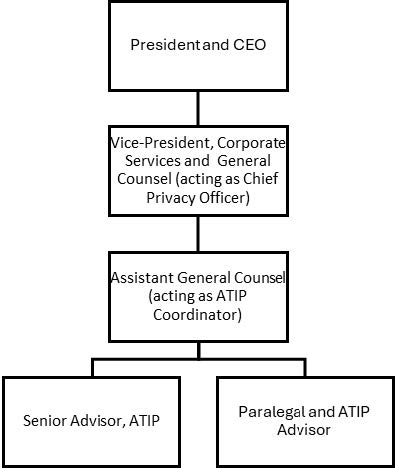
As part of a broader organizational structure review, responsibility for privacy requirements and for fulfilling privacy requests was realigned in 2025-2026. The chart below reflects CATSA’s organizational structure for administering its privacy-related responsibilities, effective April 1, 2026.
Org Chart Details
- President and CEO →
- Vice-President, Corporate Services and General Counsel (acting as Chief Privacy Officer ) →
- Assistant General Counsel (acting as ATIP Coordinator) →
- Senior Advisor, ATIP
- Paralegal and ATIP Advisor
- Assistant General Counsel (acting as ATIP Coordinator) →
- Vice-President, Corporate Services and General Counsel (acting as Chief Privacy Officer ) →
The Assistant General Counsel now acts as the institution’s Access to Information and Privacy (ATIP) Coordinator. The Senior Advisor, ATIP and Paralegal and ATIP Advisor support the ATIP Coordinator in processing requests under the Privacy Act. The Paralegal and ATIP Advisor supports the privacy policy and compliance functions.
The Vice-President, Corporate Services and General Counsel serves as CATSA’s Chief Privacy Officer (CPO). The CPO reports directly to the President and Chief Executive Officer.
CATSA’s Privacy Office responsibilities regarding the Privacy Act are:
- receive and process all requests in accordance with the Act;
- assist requesters in formulating their requests when required;
- gather all pertinent records from the program areas and ensure that the search for information is rigorous and complete;
- receive and process all disclosure requests in accordance with the Act;
- conduct the initial record review and provide recommendations to the program areas;
- conduct all internal and external consultations;
- consolidate recommendations and apply all discretionary and mandatory exemptions under the Act;
- assist the Office of the Privacy Commissioner (OPC) in all privacy-related matters including complaints against CATSA;
- prepare annual reports on the administration of the Act;
- coordinate the annual Info Source update;
- work with representatives throughout the organization to complete Privacy Impact Assessments for any new or substantially modified activity, program that collects or uses personal information;
- provide ongoing advice and guidance to senior management and staff on matters related to privacy and privacy tools;
- promote privacy of personal information awareness by providing training sessions to ensure that all staff are aware of the obligations imposed by legislation;
- respond to consultations received from external organizations;
- develop and maintain privacy policies and guidelines;
- stay current on, and promulgate within CATSA, any changes to administrative requirements for the Act from the Treasury Board of Canada Secretariat, or guidance prepared by the Office of the Privacy Commissioner; and
- participate in ATIP community activities and ATIP community meetings.
During the 2025-2026 fiscal year, CATSA was not party to any service agreements under section 73.1 of the Privacy Act.
Access to Information and Privacy Communities Development Office (APCDO) Membership
Since 2022, TBS established the Access to Information and Privacy Communities Development Office (APCDO). CATSA joined the membership to continue to develop our visibility as a smaller ATIP office.
CATSA membership has benefited from the valuable guidance on the development and training of practitioners, which in turn strengthens the ATIP community. The APCDO has hosted various workshops that give timely information about ongoing issues and guidance on how to effectively manage the Privacy Program.
III. Delegation of Signing Authority
In accordance with section 73(1) of the Privacy Act, a delegation order, signed by CATSA’s President and Chief Executive Officer (CEO), designates the person holding the position of ATIP Coordinator to exercise and perform the privacy duties on behalf of the organization.
The signed and dated delegation order is attached to this report as Annex A.
IV. Performance 2025-2026
Privacy Act Requests Received and Completed
In 2025-2026, CATSA received forty-four (44) new Privacy Act requests, which represents an increase of 100% from the 22 requests received in 2024-2025. There were two (2) requests carried over from 2024-2025. In total, CATSA was responsible for forty-six (46) requests in 2025-2026.
In 2025-2026, CATSA processed 456 pages of records and 630 minutes of video footage.
Chart I: Annual Formal Requests Received
Number of Requests Received by Fiscal Years
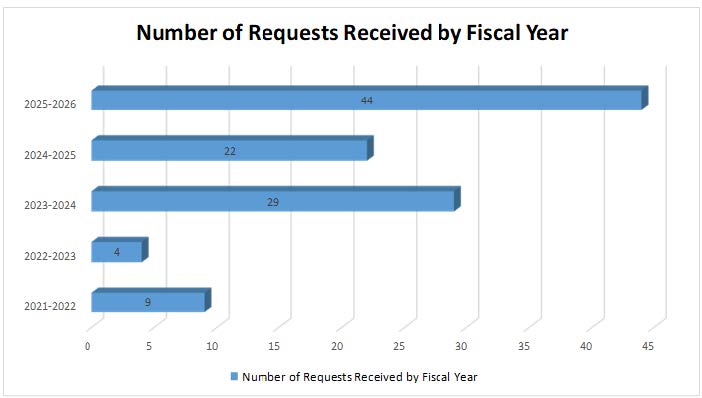
Chart I details
| Fiscal Year | Number of requests received |
|---|---|
| 2025-2026 | 44 |
| 2024-2025 | 22 |
| 2023-2024 | 29 |
| 2022-2023 | 4 |
| 2021-2022 | 9 |
Completion Time
Of the forty-six (46) requests completed during 2025-2026:
- 31 requests (67%) were completed within 30 days or less;
- 13 (28%) were completed in 31 to 60 days; and
- 2 (4.3%) were completed in 61 to 120 days.
All requests disclosed were delivered electronically. There were nine (9) requests for records in video format.
This result demonstrates CATSA's continued commitment to processing requests in a timely manner and in full compliance with the Privacy Act. While CATSA has maintained a strong level of performance, the nature of Privacy Act requests continues to evolve. An increasing proportion of requests now involve the review of security screening checkpoint footage rather than traditional paper or electronic records. These requests are considerably more complex and resourceintensive, requiring detailed review and, where necessary, redaction of security-sensitive information to ensure that individuals' access rights are respected without compromising aviation security.
Active Requests
At the end of this reporting period, CATSA had no active ongoing requests.
Complaints
CATSA received no Privacy Act complaints during the 2025-2026 reporting period.
Disposition of Completed Privacy Act Requests
The forty-six (46) completed requests consisted of:
- 19 requests disclosed in part (41%);
- 15 requests where no records existed (33%); and
- 12 requests that were abandoned (26%).
Exemptions Invoked
Where privacy exemptions were invoked, these reasons were cited:
| Reason | Exemption | Number of Cases |
|---|---|---|
| Responsibilities of Government | s.19 | 7 |
| Law Enforcement and investigations | s.22 | 1 |
| Personal information | s.26 | 1 |
Extensions
No extensions were taken during the 2025-2026 reporting period.
Complexity
During this fiscal year, the number of Privacy Act requests doubled, largely due to an increase in passenger requests to view CCTV footage captured at screening checkpoints. Processing these requests is both resource-intensive and highly complex, as each recording must be carefully reviewed to uphold individuals’ right of access to their personal information while simultaneously preventing the unauthorized disclosure of sensitive aviation security measures. In many cases, extensive redaction of video footage is required to remove information protected under section 4.79 of the Aeronautics Act, which prohibits the release of security-sensitive information that could compromise aviation security operations. Striking the appropriate balance between transparency and the protection of critical security measures demands a meticulous case-by-case assessment, making these requests among the most challenging and time-consuming files to process.
Consultations
There was one consultation received during the 2025-2026 reporting period from another Government of Canada institution. The consultation was completed within 16 to 30 days.
V. Training and Awareness
In 2025-2026, CATSA continued to strengthen privacy awareness across the organization through mandatory privacy training for new employees, ongoing communications, and professional development activities. As of December 31, 2025, 98% of employees had completed the mandatory privacy training available through CATSA's Learning Management System. The training is currently being updated and is scheduled for relaunch in fall 2026.
Throughout the year, CATSA promoted privacy awareness through intranet articles, awareness tips, and educational materials published during Privacy Awareness Week. In addition, members of the ATIP Office continued to enhance their expertise by participating in conferences, research initiatives, and privacy-related working groups.
VI. Policies, Guidelines, and Procedures
The Privacy Office continues to review our Privacy Program to improve our internal processes and procedures. We continue to update guidance on privacy based on updated tools, such as the Privacy Checklist, Privacy Protocol and Privacy Impact Assessment template.
CATSA’s Privacy Policy and Privacy Breach Response Procedure are available to all employees via the organization’s E-policy manual.
VII. Initiatives and Projects to Improve Privacy
CATSA is a strong advocate of collaboration, both internally and with the broader privacy community.
CATSA’s Privacy Program -The Privacy Office regularly engages with internal groups to provide advice, guidance and best practices on improving privacy protections.
Privacy Community – The Privacy Office also has regular consultations with other Crown Corporation privacy offices as well as with the Treasury Board Secretariat. These discussions provide an opportunity to discuss areas of concern for smaller Privacy Offices and to touch on areas that may not affect core-government institutions.
Regulatory Community – The Privacy Office actively seeks out guidance from regulators such as the Government Advisory Directorate of the Office of the Privacy Commissioner. Their offices provide informal, proactive advice and guidance on programs and activities where there are clearly privacy impacts. Their guidance has assisted CATSA in the drafting of PIAs and retention periods.
CATSA’s AI Committee - With the emergence of Artificial Intelligence (AI), CATSA established an AI Committee responsible for developing procedures necessary to support and uphold the principles, objectives, ethical considerations and operational requirements set out in CATSA’s AI Policy. As a member of the AI Committee, the Paralegal and ATIP Advisor provides guidance to ensure the development and deployment of AI systems and technologies comply with applicable privacy requirements.
VIII. Summary of Key Issues and Actions Taken on Complaints
There were no formal complaints received during the 2025-2026 reporting period. There were no ongoing complaints from previous reporting periods.
IX. Material Privacy Breaches
There were no material privacy breaches reported to the Office of the Privacy Commissioner and to the Treasury Board of Canada Secretariat (Privacy and Responsible Data Division) during the reporting period.
X. Privacy Impact Assessments
Privacy Impact Assessments (PIAs) are a tool used to ensure that the protection of personal information is considered throughout the design or re-design of a program or activity. PIAs identify the extent to which proposals comply with all appropriate statutes and legislation. They assist managers and decision-makers to avoid or mitigate privacy risks and promote only fully informed policy, program and activity design choices.
During the 2025-2026 reporting period, CATSA completed two PIAs: 1) Closed Circuit Television (CCTV) program and 2) Perimeter Security System and Support (PSSS).
CCTV program
An integral part of CATSA’s security operations is the CCTV cameras we employ at security screening checkpoints at Canadian airports. CATSA recognizes both the value of the information provided by CCTV cameras and the potentially intrusive nature of its use. CATSA is committed to ensuring that the information collected from these cameras is collected, used, retained, disclosed and disposed of in accordance with the Privacy Act.
The PIA completed this year is an update to the 2009 version of the PIA to bring it up to date with new TBS policies and procedures and updates to the CCTV technology.
Perimeter Security System and Support (PSSS)
CATSA implemented a new perimeter security system where employees have individual user profiles created that include their name, employee number, access requirements, and photo. Access at perimeter doors will be granted through a card tap and matching biometric verification.
The PIA examined the privacy risks associated with this new system.
CATSA’s PIA Summaries can be found on the corporate publications page on our website.
XI. Public Interest Disclosures
No disclosures were made under paragraph 8(2)(m) of the Privacy Act during the reporting period.
XII. Monitoring Compliance
The ATIP Coordinator meets with the Paralegal and ATIP Advisor and Senior Legal Counsel regularly to discuss and develop strategies to ensure that appropriate privacy protections are in place in contracts and information sharing agreements.
Reports on the CATSA’s Privacy Program are submitted to senior management semi-annually, with a briefing in June and in January to the Chief Privacy Officer.
Annex
Annex A: Delegation Order – Privacy Act
Privacy Act Delegation of Authority
I, Neil Parry, Interim President and CEO of CATSA, pursuant to subsection 73(1) of the Privacy Act, designate the persons holding the positions set out in the attached Schedule ‘A’, or persons acting in those positions, to exercise the powers and perform the duties and functions that have been given to me as head of a government institution under the sections of the Privacy Act, as set out in the Schedule.
Date: 2025.12.04
Neil Parry,
Interim President and Chief Executive Officer Canadian Air Transport Security Authority
Signed in Ottawa, Ontario, Canada this day of 2025
| Section | Description | ATIP Coordinator | Vice-President, Corporate Services, General Counsel and Corporate Secretary (CPO) | Senior Vice-President, Operations | Senior Director, Operations | General Manager, Program Delivery | General Manager, Corporate Security | Director HR | Senior ATIP Advisor |
|---|---|---|---|---|---|---|---|---|---|
| For requests related to passenger and non-passenger records |
For requests related to employee records | ||||||||
| 8(2)(g) | To a member of Parliament for the purpose of assisting the individual to whom the information relates in resolving a problem | Yes | Yes | No | No | No | No | Yes | No |
| 8(2)(h) | To officers or employees of the institution for internal audit purposes, or to the office of the Comptroller General or any other person or body specified in the regulations for audit purposes | Yes | Yes | No | No | No | No | No | No |
| 8(2)(i) | To the Library and Archives of Canada for archival purposes | Yes | No | No | No | No | No | No | No |
| 8(2)(j) | To any person or body for research or statistical purpose when satisfied that the purpose for which the information is disclosed meets the conditions referred to in that paragraph | Yes | Yes | No | No | No | No | No | No |
| 8(2)(k) | To any aboriginal government, association of aboriginal people, Indian band, government institution or part thereof, or to any person acting on behalf of such government, association, band, institution or part thereof, for the purpose of researching or validating the claims, disputes or grievances of any of the aboriginal peoples of Canada | Yes | Yes | No | No | No | No | No | No |
| 8(2)(l) | To any government institution for the purpose of locating an individual in order to collect a debt owing to Her Majesty in right of Canada by that individual or make a payment owing to that individual by Her Majesty in right of Canada | Yes | Yes | No | No | No | No | Yes | No |
| 8(2)(m)(i) | For any purpose where, in the opinion of the head of the institution the public interest in disclosure clearly outweighs any invasion of privacy that could result from the disclosure | Yes | Yes | Yes | Yes | No | Yes | No | No |
| 8(2)(m)(ii) | For any purpose where, in the opinion of the head of the institution, disclosure would clearly benefit the individual to whom the information relates | Yes | Yes | Yes | Yes | Yes | Yes | No | No |
| 8(4) | To keep copies of requests made under 8(2)(e), keep records of information disclosed pursuant to such requests and to make those copies and records available to Privacy Commissioner | Yes | Yes | No | No | No | Yes | No | No |
| 8(5) | To notify the Privacy Commissioner in writing of disclosure under paragraph 8(2)(m) | Yes | Yes | No | No | No | No | No | No |
| 9(1) | To retain a record of use of personal information | Yes | Yes | No | No | No | Yes | No | Yes |
| 9(4) | To notify the Privacy Commissioner of consistent use of personal information and update index accordingly | Yes | Yes | No | No | No | No | No | No |
| 10 | To include personal information in personal information banks | Yes | Yes | No | No | No | No | No | No |
| 14(a)(b) | To give notice to applicant that access will be given and to give access to requester | Yes | Yes | No | No | No | No | No | Yes |
| 15 | To extend time limit and give notice | Yes | Yes | No | No | No | No | No | Yes |
| 17(2)(b) | To have personal information translated in a language understood by the individual requesting the information | Yes | Yes | No | No | No | No | No | Yes |
| 17(3)(b) | To provide access in an alternative format for the individual to exercise their right of access their personal information | Yes | Yes | No | No | No | No | No | Yes |
| 18(2) | To refuse to disclose any personal information requested under that subsection | Yes | Yes | No | No | No | No | No | Yes |
| 19-28 | To refuse to disclose any personal information requested under that subsection | Yes | Yes | No | No | No | No | No | Yes |
| 33(2) | To make representations to the Privacy Commissioner | Yes | Yes | No | No | No | No | No | Yes |
| 35(4) | To provide access to personal information | Yes | Yes | No | No | No | No | No | No |
| 69 | To refuse to disclose a record referred to in that section | Yes | Yes | No | No | No | No | No | Yes |
| 70 | To refuse to disclose a record referred to in that section | Yes | Yes | No | No | No | No | No | Yes |
| 72(1) | To prepare annual report for submission to Parliament | Yes | Yes | No | No | No | No | No | Yes |
| 77 | To carry out responsibilities conferred on the Head of the institution by regulations made under section 77 which are not included above | Yes | Yes | No | No | No | No | No | No |
| 9 | To provide reasonable facilities and time provided to examine personal information | Yes | Yes | No | No | No | No | No | Yes |
| 11(2) | To provide notification that correction to personal information has been made | Yes | Yes | No | No | No | No | No | No |
| 11(4) | To provide notification that correction to personal information has been refused | Yes | Yes | No | No | No | No | No | No |
| 13(1) | Disclosure of personal information relating to physical or mental health may be made to a qualified medical practiotioner or psychologist for an opinion on whether to release information to an applicant | Yes | Yes | No | No | No | No | No | No |
| 14 | Disclsoure of personal information relating to physical or mental health may be made to an applicant in the presence of a qualfieid medical practitioner or psychologist | Yes | Yes | No | No | No | No | No | No |
The ATIP Coordinator is also authorized to make decisions under sections 8(1), and 8(2) (a) to (f) of the Privacy Act.
The ATIP Coordinator, the Vice-President, Corporate Services, General Counsel, Corporate Secretary (CPO), the Senior Vice-President, Operations, the Senior Director, Program Delivery, the General Manager, Program Delivery, the General Manager, Corporate Security and the Director, HR are authorized to designate in writing a member of their staff to act on their behalf in case of absence or unavailability.