
June 2026

I’m pleased to share this biannual update on CATSA’s performance, priorities, and areas of shared interest across our operations.
Our operational performance remains strong. Over the past year, 96% of passengers at Canada’s busiest airports waited less than 15 minutes to be screened, enabling us to exceed our 95/15 service target. During peak periods, 91.7% waited less than 15 minutes. This outcome was made possible through strong collaboration across the aviation community.
Alongside this performance, we continue to advance technologies and processes that strengthen detection, improve screening efficiency and effectiveness, and support a smoother passenger experience. These efforts are central to our role and to the shared goal of ensuring a secure, resilient, and reliable aviation system.
In March of this year, the Government of Canada approved CATSA’s request for funding for 2026–27. This enables us to deliver on our plan and maintain progress on critical priorities, including the innovation and service strategy commitments set out in our Strategic Plan. We are also continuing discussions with the Government of Canada on a longer‑term approach that would strengthen planning predictability further.
CATSA’s commitment to security is unwavering. Our work contributes to Canada’s broader national security framework, and everything we do is grounded in our mandate to ensure we detect, prevent, and respond to threats.
Sincerely,
Neil Parry, President and CEO (interim)
Canadian Air Transport Security Authority
Advanced Analytics in Action

CATSA is leveraging data, artificial intelligence, and machine learning to transform how we forecast demand, optimize resources, and enhance operational efficiency across Canada’s airports.
Data-Driven Planning
In our last update, we announced the deployment of a machine learning model that provides hourly passenger forecasts for the next four months at Class 1 pre-board screening (PBS) checkpoints. Building on that foundation, we are preparing to deploy an enhanced version that goes a step further by forecasting the number of screening lines required to process the projected demand.
This new capability takes throughput performance into account. It also uses smoothing constraints, which prevent sudden increases or decreases in the number of open lines from one hour to the next. Together, these improvements support more consistent decisions about when lines should open or close. The result is clearer and earlier insight into expected resource needs, supporting more precise planning, improved checkpoint flow, and a more consistent enhanced passenger experience.
Enhancing Operational Efficiency

AI Enhanced Security
CATSA’s evaluation and testing of Automated Prohibited Items Detection System (APIDS) for PBS continues to advance on multiple fronts:
- A live airport data collection exercise was launched in December using an APIDS solution on a Multi-View X-ray at Toronto Pearson International Airport. The data is being reviewed to assess detection performance and false alarm rates.
- A new internal working group was established to guide the considerations for APIDS evaluation and airport trials.
- Formal discussions with Transport Canada on the detection requirements and algorithm approval process were formally initiated.
- CATSA consulted with several international partners to review progress on certification efforts as well as airport trials in Europe and the United States.
Preliminary testing of an APIDS solution for PBS Computed Tomography (CT) X-rays is underway at CATSA’s Test Facility. The system is being tested in an “image‑on‑alarm‑only” mode, where screening officers review only the images that trigger an alarm for a potential explosive or prohibited item. This approach is designed to strengthen screening effectiveness by focusing screening officer attention on higher-risk images and improving consistency in threat detection. CATSA is working with Transport Canada to initiate a trial at a Canadian airport.
AI-Assisted Oversight
CATSA continues to advance the use of AI‑assisted oversight at non‑passenger screening (NPS) checkpoints. Following a successful first trial in 2025, a second 12-week trial at St. John's International Airport ran from January to mid-April 2026. This technology uses AI and Closed-Circuit TV to support automated oversight at NPS checkpoints and could support remote monitoring in locations without an onsite CATSA regional presence. These trials will help inform decisions on broader implementation and the development of an NPS-Terminal AI Oversight Program.
NPS 100%
In 2020, the International Civil Aviation Organization (ICAO) adopted an amended screening standard for non‑passengers. In response to Transport Canada’s direction to industry, CATSA has worked closely with airport partners to support the transition to 100% NPS screening at airports with international destinations.
Transport Canada implemented Phase 1 of the new NPS regulations in May 2025. To date, 14 airports have launched the new seasonal NPS program, and 16 airports with existing NPS operations have expanded capacity to meet the requirements to screen up to 100% of non-passengers.
Looking ahead, CATSA continues to work closely with airports to assess readiness based on parameters shared by Transport Canada. CATSA, Transport Canada and the Canadian Airports Council also participated in a tour of airports in Norway and Sweden to observe how NPS is operationalized in Europe. We remain committed to working with Transport Canada and industry partners to ensure full preparedness for Phase 2.
Checkpoint Upgrades
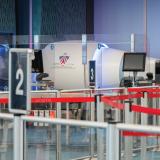
CATSA continues to modernize screening checkpoints with the deployment of PBS CT X-ray technology and CATSA Plus lines to strengthen detection capabilities and enhance the passenger experience. Since the first CT X-ray units were introduced in September 2024, 83 machines have been deployed across ten airports. CT technology enhances security, improves operational efficiency and supports an improved passenger experience.
Trials of the CATSA Plus modular lines at Toronto Pearson International Airport and Quebec City Jean Lesage International Airport have demonstrated that shorter lines, when combined with CT X-rays, can deliver higher throughput than traditional multi-view X-rays and roller tables. These modular lines will be deployed in select checkpoints with significant space constraints.
For checked baggage screening, CATSA recently completed an upgrade of the detection algorithm on its fleet of CTX 9800 high-speed CT X-rays. This new algorithm enhances CATSA’s detection capabilities and ensures CATSA is harmonized with its partners.
Collaboration and Partnerships

CATSA continues to strengthen collaboration across the aviation sector, recognizing that shared insights and a coordinated approach improve the efficiency and resilience of the entire aviation ecosystem. CATSA participated in several aviation-security panels at the Passenger Terminal Expo in March, providing opportunities to engage with Canadian airport authorities, equipment suppliers and international partners.
Data Sharing Working Group
As part of efforts to enhance operational value and situational awareness across the aviation ecosystem, CATSA is pleased to participate in a Canadian Airports Council–led Data Sharing Working Group. This group is focused on establishing a minimum data set, governance framework and roadmap for an Aviation Data Exchange. Through workshops and interviews, the working group is bringing together airports, airlines and federal agencies to build consensus on how data can be shared more effectively to support coordinated decision‑making.
Checkpoint Accessibility Project
CATSA remains committed to improving accessibility at screening checkpoints by advancing inclusive solutions that enhance comfort, independence, and the overall experience for travellers with diverse needs.
In January 2026, CATSA engaged the Rick Hansen Foundation (RHF) to conduct an on-site accessibility assessment of the domestic/international and transborder PBS checkpoints at Ottawa International Airport. The assessment reviewed the screening environment from the perspective of travellers with varying accessibility needs, identifying both strengths and opportunities for improvement. RHF will provide a scorecard and recommendations to guide CATSA’s implementation of the 2026–2029 Accessibility Action Plan and help prioritize future initiatives. We look forward to working with airport partners to advance solutions that support a more seamless and inclusive experience for travellers with accessibility needs.
CATSA by the Numbers

As part of our commitment to transparency, CATSA maintains a dedicated Key Performance Indicator (KPI) webpage that highlights overall service metrics and performance. Updated quarterly, it provides a clear view of service levels and reinforces our accountability to the public and our partners.